|<◊|ψ>|²
under construction...
(for a very long time)
Abstract Algebra Basics
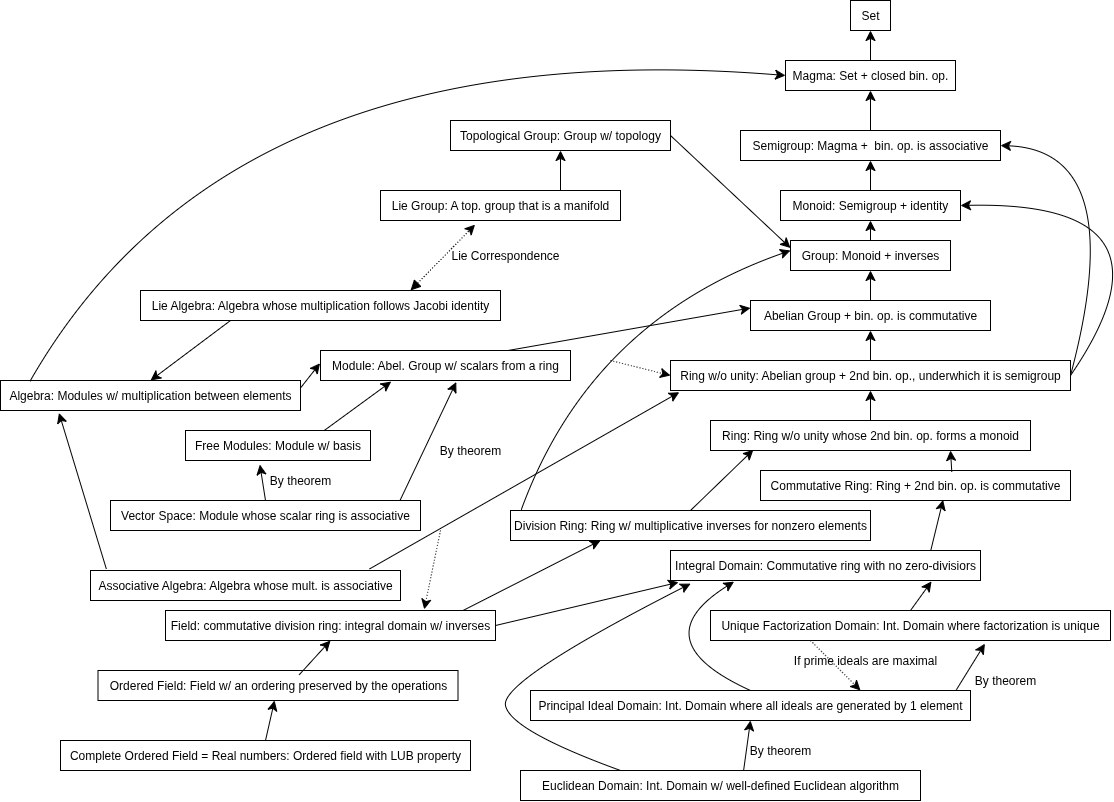
An algebraic structure is a (non-empty) set equipped with a series of operations. Among algebraic structures, frequently used structures include groups, rings, monoids, semigroups, modules, etc.
An algebra is a vector space where vectors can be added and multiplied. As a simple example, since $n \times n$ matrices can be multiplied with each other, we can immediately think of $M_n(\mathbb{R})$ itself as an algebra.
A Magma is an algebraic structure with no additional conditions other than a set and a binary operation on it. That is, it refers to a set equipped with a function that assigns a unique element $m \cdot n \in M$ to any pair of elements $m, n \in M$.
A Semigroup is defined as $S$ when $S$ is a set and $\cdot : S \times S \rightarrow S$ is a binary operation satisfying the associative law. In other words, a semigroup is an associative magma.
A Monoid is an algebraic structure that satisfies the axioms of associativity and identity element.
A group is a set with multiplication, inverse elements, and identity element defined.
A Pseudoring is a set with multiplication/addition binary operations, additive inverse/identity defined.
A ring is an algebraic structure with addition and multiplication defined. Specifically, a ring $(R, +, \cdot, 0, 1)$ is a set equipped with binary operations $+: R \times R \rightarrow R, \cdot: R \times R \rightarrow R$ and satisfying the following axioms:
- $(R, +)$ forms an abelian group. (additive associativity/commutativity/identity existence/inverse existence)
- $(R, \cdot)$ forms a monoid. (multiplicative associativity/identity existence)
- The distributive law holds between addition and multiplication. (right/left distributive laws)
A field is a division ring that is a commutative ring. That is, $(K, +, \cdot, 0, 1)$ satisfying the following conditions is called a field:
- For the additive identity $0$ and multiplicative identity $1$ of the field, $0 \neq 1$
- All elements except $0$ are invertible elements
The set of scalars is a field.
A vector space is an additive abelian group.
A Module is an abelian group very similar to a vector space, but where the scalars need not necessarily be a field. An $R$-module is a generalized vector space over a ring $R$. A vector space is a special case where $R = \mathbb{F}$.
An Algebra over a field $\mathbb{F}$ is a structure with a vector space $A$ and a bilinear product $\mu: A \times A \rightarrow A$ that is associative and has a unit 1. Examples include $M_n(\mathbb{F})$, polynomial algebra $\mathbb{F}[x_1, \ldots, x_m]$, exterior algebra $\Lambda V$, and tensor algebra $T(V)$.
TBA
A $\sigma$-algebra is a mathematical model of partial knowledge states about outcomes. Given a probability space $(\Omega,\Sigma,P)$, let the set $\Omega$ be the set of possible outcomes of a probability experiment. Let the elements of $\Omega$ be $\omega$ in the sample space. For example, when $\Sigma$ is a $\sigma$-algebra and $A\in\Omega$, regardless of whether $\omega\in A$ or not, $A\in\Sigma$. A Semiring is a collection of sets $F$ that satisfies the following conditions:
- $\Phi\in F$, where $\Phi$ is the empty set
- If $A,B\in F$, then $A\cap B\in F$
- If $A,B\in F$, then there exists a collection of sets $C_1,\dots,C_n\in F$ such that $A\backslash B = \bigcup_{i\geq1} C_i$ (where $A\backslash B$ represents all elements of $A$ not in $B$)
An Algebra is a collection of sets $F$ that satisfies the following conditions:
- $\Phi\in F$
- If $\omega_1\in F$, then $\omega_1^c\in F$ ($F$ is closed under complementation)
- If $\omega_1\in F$ and $\omega_2\in F$, then $\omega_1\cup\omega_2\in F$ ($F$ is closed under finite unions)
A $\sigma$-algebra is a collection of subsets $\omega$ of $\Omega$ when $F$ satisfies the following conditions:
- $\Phi\in F$
- If $\omega\in F$, then $\omega^c\in F$
- If $\omega_1,\dots\omega_n\in F$, then $\bigcup_{i\geq 1}\omega_i\in F$
Every $\sigma$-algebra is an algebra, but the converse does not hold. It is closed under finite and countable unions and intersections.
A Borel $\sigma$-algebra is the intersection of all $\sigma$-algebras of subsets of $\mathbb{R}$ that contain all open sets. The collection of such Borel $\sigma$-algebras is called a Borel set. It contains all $\sigma$-algebras that include the entire collection of open sets.
The exterior algebra is an algebraic system that produces the wedge product (exterior product). While the result of the outer product is a vector (a value with one specific direction), the result of the wedge product (exterior product) is a bivector (a value with two specific directions) - an oriented plane.
TBA